
An order comes in from Rozetka or Prom
Before a manager checks each marketplace account separately and copies orders by hand.
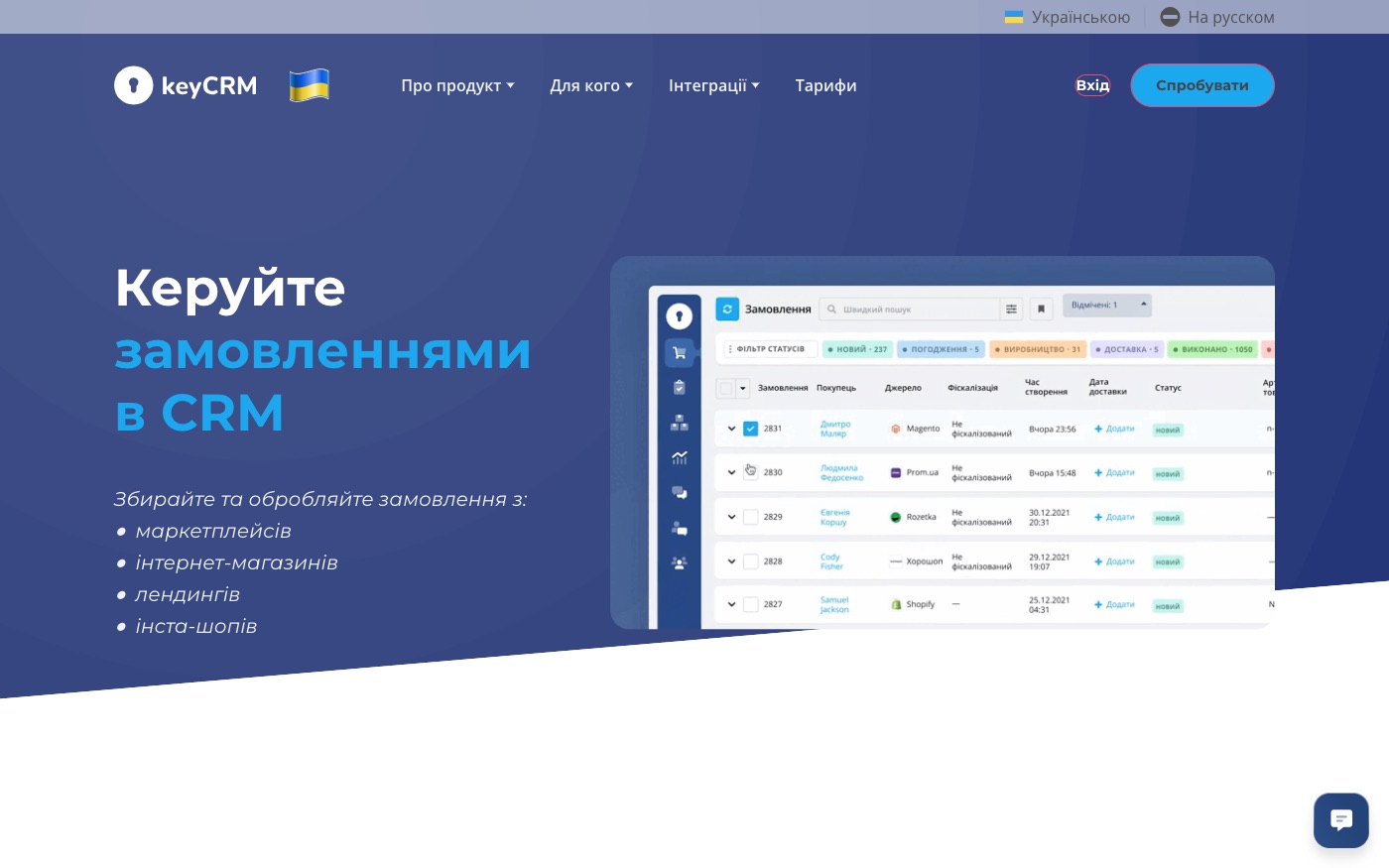
After the order lands straight in the same KeyCRM pipeline as website orders — no manual transfer.
 CRMUA
CRMUAUkrainian CRM that pulls orders from your site, marketplaces and chat apps into one pipeline
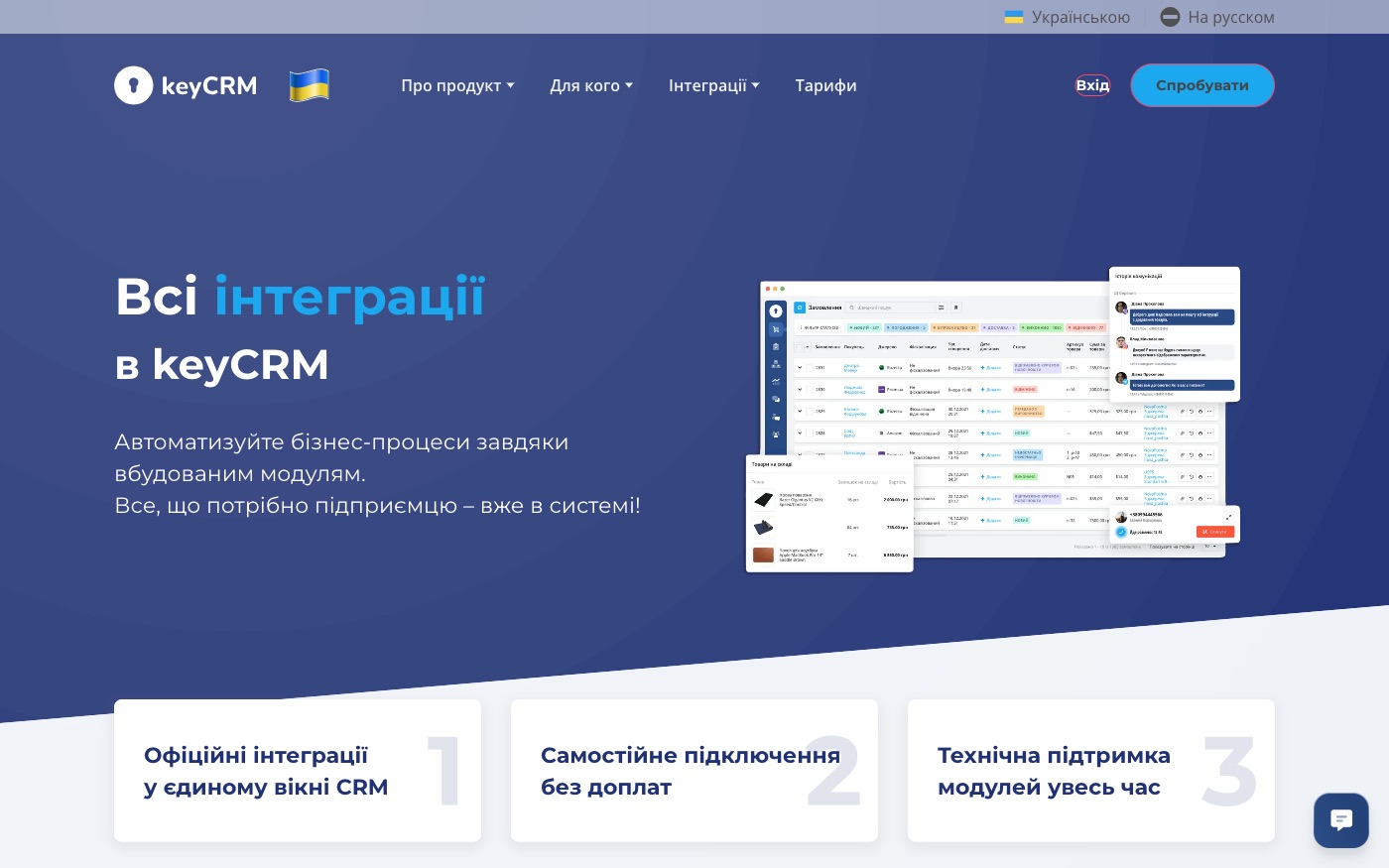
KeyCRM pulls orders from your website, marketplaces and messenger chats into one place. It already has built-in links to Nova Poshta, Checkbox and several telephony providers — they start working right after we connect them. Where a ready-made link doesn't exist, we build one ourselves, using the way KeyCRM lets outside systems exchange data with it.
Before a manager checks each marketplace account separately and copies orders by hand.
After the order lands straight in the same KeyCRM pipeline as website orders — no manual transfer.
Before the manager writes down who called and why in a separate notepad.
After the call history shows up right in the customer's card — thanks to the ready-made KeyCRM-Binotel link.
Before the warehouse finds out an order is paid only when the manager remembers to mention it.
After the moment payment status changes, KeyCRM passes that information straight to the warehouse or a Telegram bot — no calls, no reminders.
Before a cashier punches the receipt by hand and copies order data into the till.
After Checkbox is on KeyCRM's list of ready-made links, so the register connects to the order flow instead of being built from scratch.
Before a stalled deal is noticed only during a manual review of the pipeline.
After an automation rule with a delay of up to 30 days moves the card or creates a task for the manager on its own.
For those who want to check: each point links to the official documentation page it comes from.
API authentication uses a Bearer API key created in CRM settings, not OAuth.
Source: help.keycrm.app ↗ checked 2026-09-25The API limit is 20 requests per minute per key; exceeding it returns a 429 Too Many Requests error.
Source: help.keycrm.app ↗ checked 2026-09-25The Open API covers orders, funnel/deal cards, customers, companies, products and stock, files, payments and call history.
Source: help.keycrm.app ↗ checked 2026-09-25Webhooks in KeyCRM are outgoing only and are set up through automation; they cover exactly three events: order status change, order payment status change, funnel card status change.
Source: help.keycrm.app ↗ checked 2026-09-25KeyCRM makes 3 delivery attempts for each webhook and waits for a 200 response from the receiving server; otherwise it stops sending.
Source: help.keycrm.app ↗ checked 2026-09-25The REST API and all native integrations are part of KeyCRM's single plan — there's no separate paid tier just for API access.
Source: keycrm.app ↗ checked 2026-09-25Up to 200 automation rules and 25 warehouses per account. The API limit is 20 requests per minute per key. The monthly cap on orders, leads and chat messages depends on the plan.
Three steps from a first message to work on your project.
Describe the task in the form — in text or by voice. Budget and timing are optional.
A developer studies the brief, asks about anything unclear and sends an estimate.
Once scope and price are agreed, the work begins.
or write to info@coreviaflow.space
Describe the task in text or a voice message. We look at your setup and reply with a plan.
Four services people come to us for most often. Each page explains what we do, how the work goes and where to start.
Choose the system, set up the pipeline, migrate data, train the team.
Learn more →Accounting, telephony, website, payments and messengers feed the CRM on their own.
Learn more →Orders, requests and answers around the clock, straight into your CRM.
Learn more →Flows between CRM, email, spreadsheets, payments and AI, on your own server.
Learn more → IP telephonyUA
IP telephony with ready-made CRM links and one-click calling
See scenarios → Payments & POSUA
The cash register that sends the receipt to the tax office the moment payment goes through
See scenarios → IP telephonyUA
IP telephony with ready CRM connections and call alerts at the exact moment you need them
See scenarios → CRMUA
CRMUAThe CRM built for order-taking: every lead from every channel lands in one place on its own
See scenarios → CRMUA
CRMUADeals, calls and documents move through Bitrix24 on their own, tracked step by step
See scenarios → CRMUA
CRMUASelling goods through LP-CRM? We connect it to everything else your business runs on
See scenarios →Implementation · Development · Integrations →
KeyCRM is a trademark of its owner. CoreviaFlow is not affiliated with it unless stated otherwise. Screenshots are taken from public vendor materials; the source is shown under each one.